AI resume tools are everywhere, but do recruiters actually accept them? Here's what the data says, and where AI helps vs hurts your chances.
More than half of job seekers now use AI tools to help write their resumes. At the same time, a growing number of recruiters say they can spot an AI-written resume instantly, and some claim they reject them outright. So which is it: a smart use of available tools, or a fast track to the rejection pile? The honest answer is that both sides of this debate are partially right, and the part they're each missing is the part that actually determines whether it works for you.
Here's what the data shows, what recruiters actually think, and how to use AI on your resume in a way that helps rather than hurts.
TLDR
Over 50% of job seekers use AI tools to help write resumes, according to surveys from multiple job search platforms.
Most recruiters accept AI-assisted resumes. The concern is specifically with resumes that sound generic, templated, or obviously mass-produced.
AI is genuinely useful for keyword optimization, formatting, and ATS compatibility. Where it often fails is personality and specificity.
The approach that works: use AI as a starting point, then edit heavily to add your voice and specific details. Or use tools designed to tailor to each role rather than generate a generic document.
The case for using AI on your resume
Let's start with the practical benefits, because they're real.
Keyword optimization. This is where AI tools add the most clear-cut value. ATS software screens resumes for specific terms that appear in the job description. If you have the relevant experience but describe it differently, you get filtered out before any human reads your application. AI tools that analyze job descriptions and adjust your resume language accordingly solve this problem directly and consistently, something that's difficult to do well manually, especially across dozens of applications.
Formatting and structure. Most people don't think carefully about resume formatting, and many default to templates that look good on screen but parse badly in ATS systems. AI tools that output clean, ATS-compatible formatting, single column, standard section headings, no graphics, help you avoid one of the most common mechanical reasons for rejection.
Getting unstuck. If you've been staring at a blank document for two hours trying to describe your previous job in a way that sounds professional, an AI draft gives you something to react to, edit, and improve. That's much faster than starting from nothing. The draft doesn't have to be perfect. It just has to be better than a blinking cursor.
Consistency and completeness. AI tools tend to prompt for information you might otherwise forget: quantified achievements, relevant skills, proper education formatting. They can catch gaps that you'd miss because you know your own background too well to notice what's missing.
Volume. If you're applying to 20 or 30 jobs per week, manually tailoring your resume for each role isn't realistic. AI tools that handle per-application tailoring automatically are the only practical way to apply at meaningful volume without sacrificing resume quality. Ace is built specifically for this - it tailors and submits for every job you swipe on.
The case against using AI on your resume
The backlash against AI resumes isn't groundless. There are real failure modes.
Generic language. AI writing tools, when given minimal input or allowed to run without heavy editing, tend to produce confident-sounding but ultimately hollow sentences. Phrases like "results-driven professional with a proven track record of delivering impactful outcomes" have become shorthand in recruiting circles for "written by AI, probably not edited." When a recruiter reads 50 resumes and 30 of them open with nearly identical language, the ones that don't stand out immediately.
Loss of specificity. AI tools produce text based on patterns, not on the specific details of your career. If you don't provide rich, specific input, the output is going to be vague. A human-written bullet that says "cut customer churn by 18% over 6 months by redesigning the onboarding email sequence" is more compelling than anything an AI will generate without that information. The AI doesn't know your actual results. You do.
Overconfidence about qualifications. Some job seekers use AI to make themselves sound more senior or experienced than they are. This might get you through ATS screening, but it creates a significant problem in interviews when the claims on your resume don't hold up in conversation. Recruiters have seen this pattern enough that it's become a reason to scrutinize AI-generated resumes more closely.
Detectable patterns. Experienced recruiters genuinely do recognize AI-generated text at higher rates than is commonly assumed. Specific phrases, sentence structures, and the particular way AI tools organize information have become recognizable. This is less of a problem if you've edited heavily. It's more of a problem if you've copied and pasted with minimal changes.
What recruiters actually think
The picture from surveys and recruiter commentary is more nuanced than either "AI resumes are fine" or "recruiters hate them."
Research from multiple HR platforms, including surveys by Tidio, Resume Genius, and others conducted in 2024 and 2025, suggests that a significant majority of hiring professionals accept AI-assisted resumes, with some surveys putting this figure at over 70%. What they object to is not AI assistance per se. It's the output of AI assistance that hasn't been edited: generic language, missing specifics, and resumes that read as if they could have been written for any person applying to any job.
The distinction recruiters consistently draw is between AI as a tool and AI as a replacement for effort. Using AI to optimize your keywords, tighten your formatting, and generate a starting draft that you then edit and personalize: most recruiters are fine with that, in the same way they'd be fine with you using Grammarly to clean up grammar. Submitting a raw AI output with your name dropped in at the top: that's the version that gets flagged.
The other thing worth noting is context. Recruiter attitudes vary significantly by industry, company size, and the seniority of the role. A large tech company receiving thousands of applications for an entry-level role may have less patience for any sign of low-effort applications. A smaller organization hiring for a creative or communications role where voice and personality matter will notice generic language more than a role where the resume is primarily being used to verify specific technical qualifications.

How to use AI without sounding generic
The approach that works is using AI as a starting point, not a finished product.
Provide rich, specific input. The quality of the AI output depends almost entirely on the quality of what you give it. If you ask an AI tool to write a bullet point for your marketing role without telling it what you actually achieved, it will generate something generic. If you tell it "I ran email campaigns that grew our list by 40% and increased open rates from 18% to 27% over six months," it has something real to work with. Give it the facts and let it shape the language.
Edit for your voice. Read the AI draft out loud. Identify every sentence that sounds like marketing copy rather than a person. Rewrite those sections. The goal is a document that reflects how you'd describe your own career to someone you respect, clear, specific, and honest, without the filler phrases and corporate-speak that AI tends to default to.
Customize per role. A resume that was optimized for one job description but sent to fifty different roles has gained nothing in the tailoring step. Keyword optimization only works if it's done for the specific job you're applying to. Either do this manually for each application (which takes time) or use a tool that handles per-application tailoring automatically. If you're applying at any real volume, the manual route isn't sustainable - Ace handles the per-role tailoring for you so you're not choosing between speed and quality.
Check the specifics. Make sure every claim on the AI-generated resume is accurate and something you can speak to in an interview. Numbers, achievements, tools, and job titles all get tested. If the AI embellished something, correct it.
Keep your personality. Your resume will spend approximately 7 seconds in front of a human if it clears the ATS. In that 7 seconds, something has to make you memorable. Generic AI language doesn't do that. A specific achievement, an interesting career path, or a well-phrased summary that speaks directly to the role might.
The best AI resume tools in 2026
Not all AI resume tools work the same way. Some generate static documents. Some do per-application tailoring. Some focus on the writing. Some focus on the submission. Here's how the main categories break down.
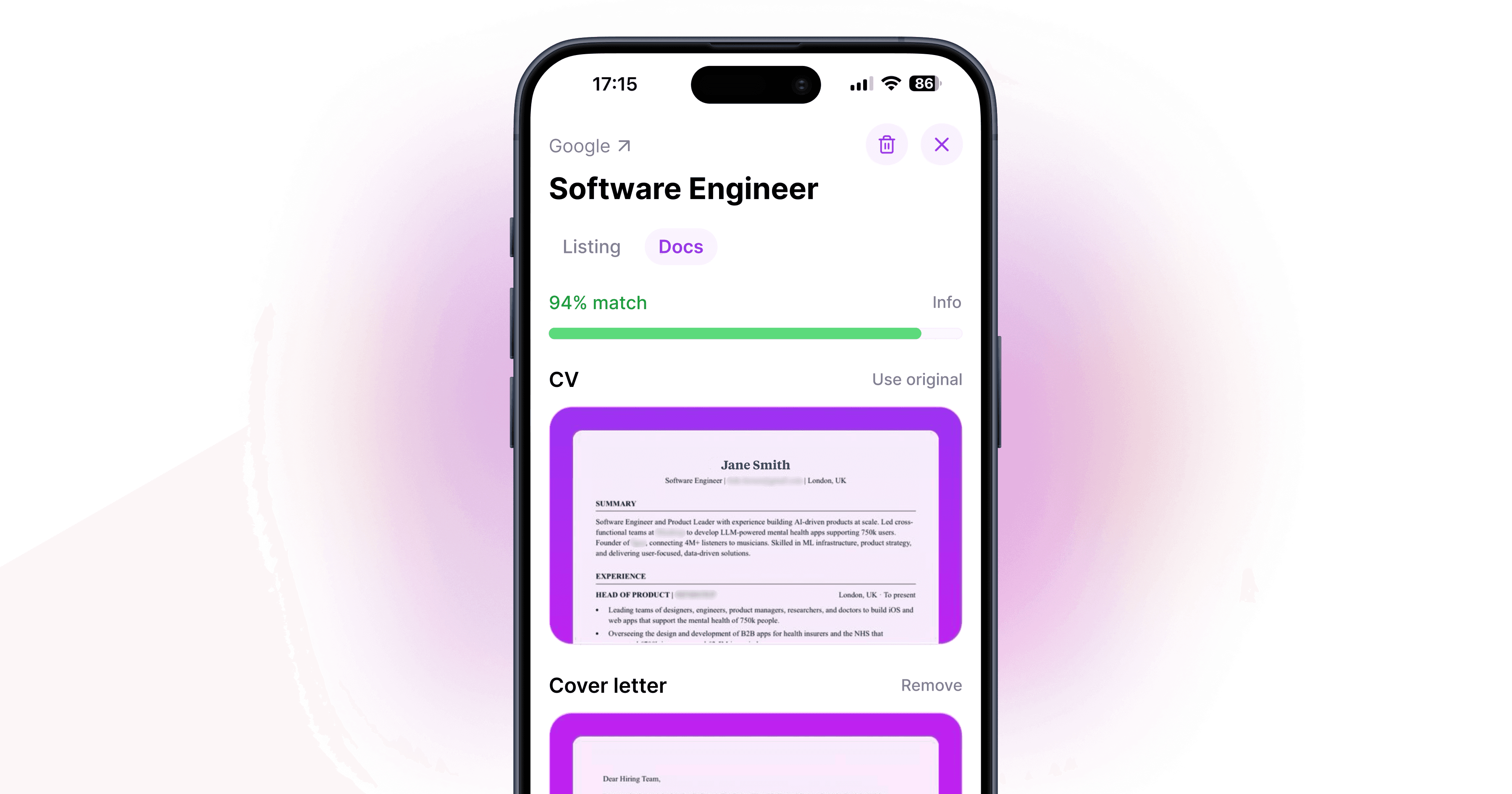
For per-application tailoring at scale: Ace analyzes each specific job description and automatically tailors your resume and cover letter for that role before submitting the application on your behalf. If you're applying to 20 or more jobs per week, this is the only practical way to send genuinely tailored applications without spending your evenings editing documents. The output is optimized for ATS compatibility and written in your voice based on the base resume you upload. Try Ace free on iOS and Android.
For standalone resume writing and optimization: Rezi is one of the strongest dedicated resume builders in the market. It analyzes job descriptions, identifies missing keywords, scores your resume against 23 ATS criteria, and provides specific guidance on what to improve. It doesn't apply for you, but if you want to deeply understand your resume's performance and improve it systematically, it's a well-developed tool. See our full breakdown: Best AI Job Search Tools in 2026.
For general AI writing assistance: Claude, ChatGPT and similar general-purpose tools can help you draft and edit resume content when given specific, detailed input about your actual experience. The output requires more editing than a purpose-built resume tool, but they're free and flexible. Useful for getting unstuck or generating alternative phrasings for bullet points you've been staring at too long.
The honest verdict
AI assistance on your resume is not cheating, not going to get you rejected, and not a substitute for having real experience and describing it accurately.
The job seekers who get it wrong are the ones who treat AI as a way to make their application look better than their background actually is. The ones who get it right are the ones who use AI to make their actual background more visible, through better keyword matching, cleaner formatting, and clearer language, and then edit the output until it sounds like a person wrote it.
The best version of AI-assisted job searching isn't a human pretending to be a machine or a machine pretending to be a human. It's the combination of your specific career history and the efficiency of automation. You bring the experience. The tools handle the repetitive work.
For a practical guide to making sure your resume passes ATS screening before it ever reaches a recruiter, see: How to Beat Applicant Tracking Systems in 2026.
And for the most common resume mistakes that cause rejection at the first screening stage, including several that AI tools can inadvertently introduce, see: 10 Resume Mistakes That Get You Instantly Rejected.
See how Ace handles resume tailoring automatically - free on iOS and Android
Questions about AI job search tools or resume strategy? Reach out at info@aceapp.ai.
FAQ
Do recruiters reject AI-written resumes?
Most recruiters don't reject AI-assisted resumes outright. Research from multiple HR platforms suggests over 70% of hiring professionals accept them. What gets rejected is the specific output of AI assistance that hasn't been edited — generic language, hollow phrasing, and resumes that read as if they could have been written for any candidate applying to any job.
Can recruiters tell if a resume was written by AI?
Experienced recruiters can often identify unedited AI output. Certain phrases, sentence structures, and organizational patterns have become recognizable. If you've edited the AI draft heavily and added specific, verifiable details from your actual experience, it's much harder to identify, and largely indistinguishable from a well-written human resume.
Is using AI on a resume cheating?
No. Using AI to optimize your keywords, improve formatting, and generate a starting draft is no different from using Grammarly, a resume template, or a professional resume writer. What matters is that the content accurately represents your experience and is something you can speak to in an interview.
What is the best AI tool for writing a resume?
For per-application tailoring at scale, Ace automatically rewrites your resume to match each specific job description before submitting the application. For standalone resume building and optimization, Rezi analyzes job descriptions, identifies missing keywords, and scores your resume against 23 ATS criteria. For getting unstuck on specific sections, ChatGPT with detailed input about your actual experience works well as a drafting aid.
How do I use AI on my resume without sounding generic?
Give the AI specific, detailed input: actual metrics, real achievements, concrete tool names. Then edit the output heavily until it sounds like you wrote it. Read it out loud and rewrite anything that sounds like marketing copy. Customize for each specific role rather than using the same AI output everywhere.