Some do. Some don't. The answer depends on the role, the company, and what your cover letter actually says. Here's what the research shows.
The cover letter debate has been running for years. One camp says cover letters are dead — recruiters are too busy to read them and most hiring decisions are made from the resume. The other camp says a strong cover letter can make or break a candidacy. Both positions are true, depending on the context. The honest answer is more nuanced than either — and understanding the nuance helps you decide when to invest the time and when to skip it.
TLDR
Research suggests most recruiters read cover letters when they're provided — but many also say they're not decisive for most roles.
Cover letters matter most for: senior roles, roles requiring communication skill, competitive positions at culture-driven companies, and any role where you need to explain something your resume can't.
They matter least for: high-volume technical roles, positions filled through ATS-heavy screening, and roles where skills verification is the primary filter.
A bad cover letter can hurt you. A good one can break a tie. A missing one is rarely disqualifying.
What the research actually shows
Multiple surveys of hiring professionals produce roughly consistent findings. A Resume Genius survey found that the majority of hiring managers read cover letters when provided. A LinkedIn survey found that cover letters are considered important by a significant proportion of hiring managers, though not universally. Research from ResumeGo found that applications with tailored cover letters were meaningfully more likely to receive callbacks than those without.
The consistent finding across studies: cover letters are read more often than candidates assume, matter more in specific contexts than in others, and a tailored cover letter consistently outperforms a generic one or none at all.
What this means in practice: don't skip the cover letter just because you've heard it doesn't matter. The evidence doesn't support that conclusion.
When cover letters matter most
Senior and leadership roles. At director level and above, the cover letter is often read carefully because the hiring decision involves assessing judgment, communication style, and cultural fit — things that a resume demonstrates less clearly. A senior professional who can't write a compelling cover letter raises a question about their communication capability.
Roles where writing is part of the job. Marketing, communications, content, PR, legal, consulting, and similar roles. The cover letter is itself a writing sample. A recruiter hiring for a content strategist who receives a poorly written or generic cover letter has already learned something about the candidate.
Culture-driven companies and mission-led organizations. Companies where cultural alignment is a primary hiring criterion use the cover letter to assess genuine interest and fit. A cover letter that references something specific about the company's mission or approach signals that the candidate did real research.
When your resume needs context. A career change, an employment gap, a non-traditional background, or a move into a new industry — these are situations where the resume creates questions that a cover letter can answer. Without a cover letter, those questions remain unanswered.
Competitive roles at any level. When a role receives hundreds of applications and two candidates are similarly qualified, the one who wrote a compelling cover letter has a marginal but real advantage.
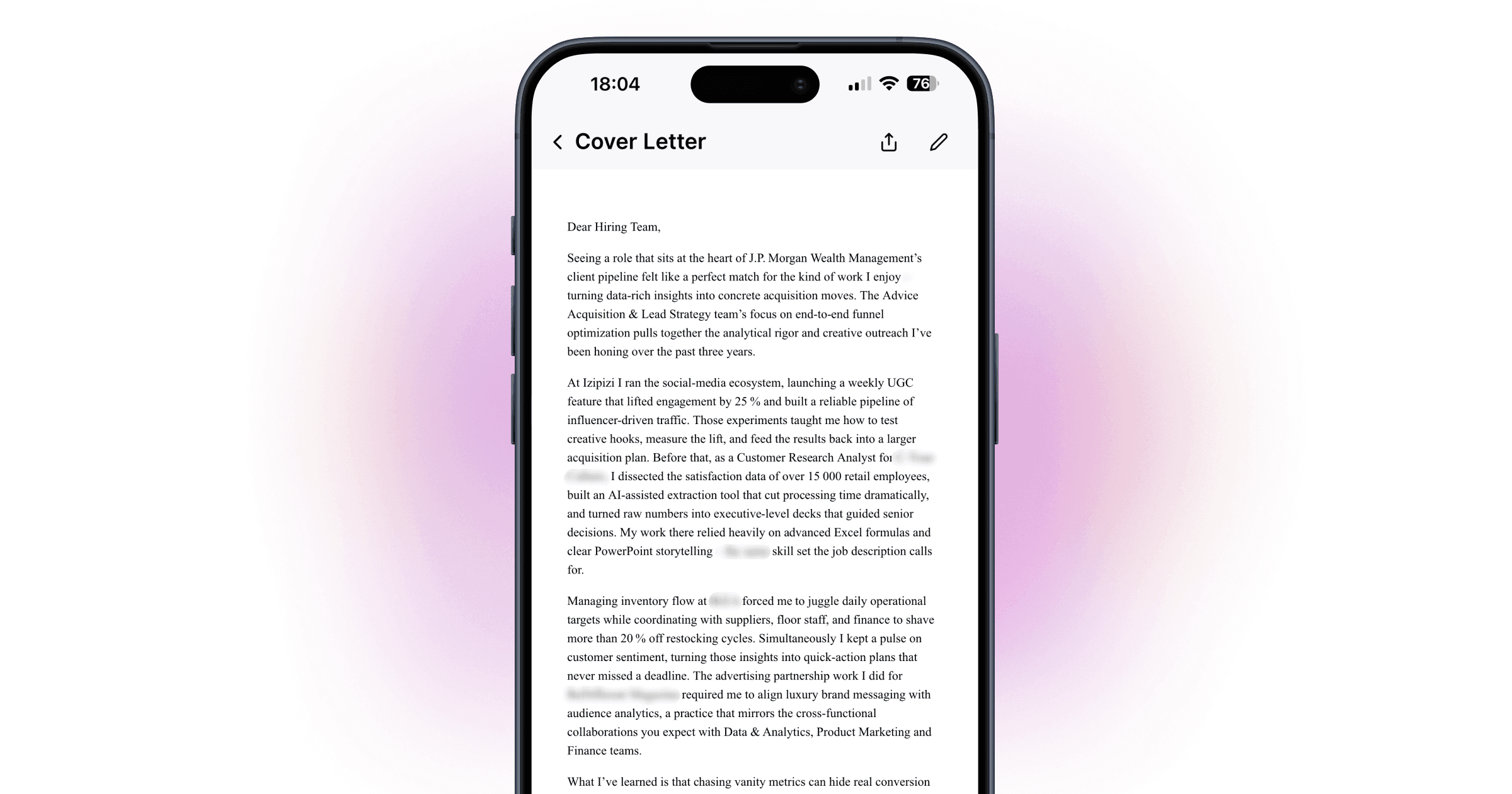
Ace writes a tailored cover letter for every application automatically — free on iOS and Android
When cover letters matter less
High-volume technical roles. Software engineering, data science, and similar roles where the hiring decision is primarily skills-based. A GitHub portfolio or technical assessment carries more weight than a cover letter.
Roles filled primarily through ATS screening. If a company is receiving 500 applications and using ATS to get to a shortlist of 20, the ATS screening happens before most cover letters are read.
When the application portal doesn't ask for one. If there's no cover letter field, don't attach one unsolicited — it won't be read and creates extra work for the reviewer.

The practical decision framework
Write a cover letter when:
The role asks for one (always)
The role is senior, involves communication skill, or is at a culture-driven company
Your background needs context that the resume doesn't provide
It's optional and you have time — a tailored letter still helps
Skip or deprioritize when:
The application portal has no cover letter field
You're applying at very high volume and would write generic letters — a generic cover letter is worse than none
The role is highly technical and the primary assessment is skills-based
The key is the word "tailored." A cover letter that references this specific company and this specific role's requirements is worth writing. A cover letter that opens with "I am writing to apply for the position" and runs to a second page is not.
For guidance on writing a cover letter that actually gets read: How to Write a Cover Letter That Actually Gets Read.
The bottom line
Most cover letters aren't read — but the ones that are can be decisive. The question isn't whether to write one, it's whether to write one worth reading. A specific, concise letter tailored to the role outperforms no letter, and no letter outperforms a generic one. For volume applications, Ace generates a tailored cover letter automatically for every job so you don't have to choose between quality and scale.
For how to write one that earns a read: How to Write a Cover Letter That Actually Gets Read. For the mistakes that make them ineffective: Cover Letter Mistakes: Why Yours Isn't Getting Read.
Ace generates a tailored cover letter automatically for every job — try it free on iOS and Android
FAQ
Is a cover letter necessary for a job application?
Not always legally required, but beneficial in many contexts. When a cover letter is requested, it's mandatory. When optional, a good tailored cover letter improves your chances — particularly for senior, communication-heavy, or competitive roles.
Do hiring managers actually read cover letters?
Research suggests most do read them when provided, though they spend less time on them than on resumes. The cover letter is read after the resume if the resume creates interest — so the resume still needs to pass the initial scan first.
Can a bad cover letter get you rejected?
Yes. A cover letter with spelling errors, generic language, or obvious template signs can override a strong resume impression. This is why a generic cover letter is often worse than no cover letter.
Should cover letters be sent for online applications?
If the online application has a cover letter field, yes. If it doesn't, don't attach one to a different field — it typically won't be read.
What's the single most important thing a cover letter needs to do?
Earn the reader's attention in the first sentence. If the opening line gives no reason to keep reading, the rest of the letter is irrelevant. A specific, concrete opening (a relevant achievement, a genuine reason for this role) is what separates letters that get read from those that don't.