Most cover letters are skipped or skimmed. Here's the structure and language that makes recruiters stop and read yours properly.
The reason most cover letters don't get read isn't that recruiters are lazy or that cover letters don't matter. It's that most cover letters are bad in specific, predictable ways — and recruiters learn to skim them because the signal-to-noise ratio is so low. A cover letter that doesn't open with something specific, doesn't say anything the resume doesn't already say, and ends with a generic "I look forward to hearing from you" provides no reason to read it carefully. The ones that do get read are different in three specific ways.
TLDR
Cover letters that get read are specific, concise, and make an argument the resume doesn't explicitly make.
The first line is the only one guaranteed to be read. It needs to earn the second.
Three paragraphs, under 250 words, is the right length.
Structure: why this role + what you bring + why this company. In that order.
The structure that works
Every effective cover letter answers three questions in order:
Why this role? Not "I have always been passionate about marketing." Something specific to this job at this company. What about this particular role, at this particular company, is compelling to you — and how does that connect to where you've been?
What do you bring? Not a summary of your resume. One or two specific experiences or achievements that map directly to the core requirements of this role. With numbers if you have them. The argument that your background isn't just relevant — it's a strong match for what they actually need.
Why this company? Something real. A product you use, a problem they're solving that matters to you, a specific thing about the culture or direction that makes this feel like the right move rather than just any job. This doesn't need to be long — one sentence is enough if it's genuine.
The first line: the most important sentence you'll write
The opening sentence of your cover letter is the only one guaranteed to be read. If it earns the reader's attention, they'll read the rest. If it doesn't, the rest is irrelevant.
The most common opening sentences are also the most useless:
"I am writing to apply for the position of..."
"I am excited to submit my application for..."
"Having read your job description, I believe I would be a great fit..."
Every one of these tells the recruiter nothing they don't already know. Start with something that earns the second sentence instead.
Openings that work:
"Three years ago I rebuilt our email onboarding sequence and cut first-week churn by 22%. This role is doing the same thing at a scale I haven't had access to yet."
"I've been using [Company]'s product daily for two years — which is also how long I've been watching you approach the B2B acquisition problem in a way nobody else in the market is. That's why I'm applying."
"The combination of machine learning engineering and customer-facing communication this role requires is unusual, and it matches how I've been working for the last three years."
These work because they're specific, they create immediate relevance, and they make the reader want to know more.
Ace writes a tailored cover letter for every application automatically — free on iOS and Android
Length and format
Three short paragraphs. Under 250 words. No exceptions.
If your cover letter is longer than that, it hasn't been edited. Trim every sentence that doesn't advance the argument. Cut adverbs. Remove "I believe" and "I feel" and replace with direct statements. Remove the final paragraph that says something like "I would be delighted to discuss my application further" — this is implied and adds nothing.
Format: plain text, no header graphics, addressed to a real person if you can find their name. The same professional presentation as a business email.
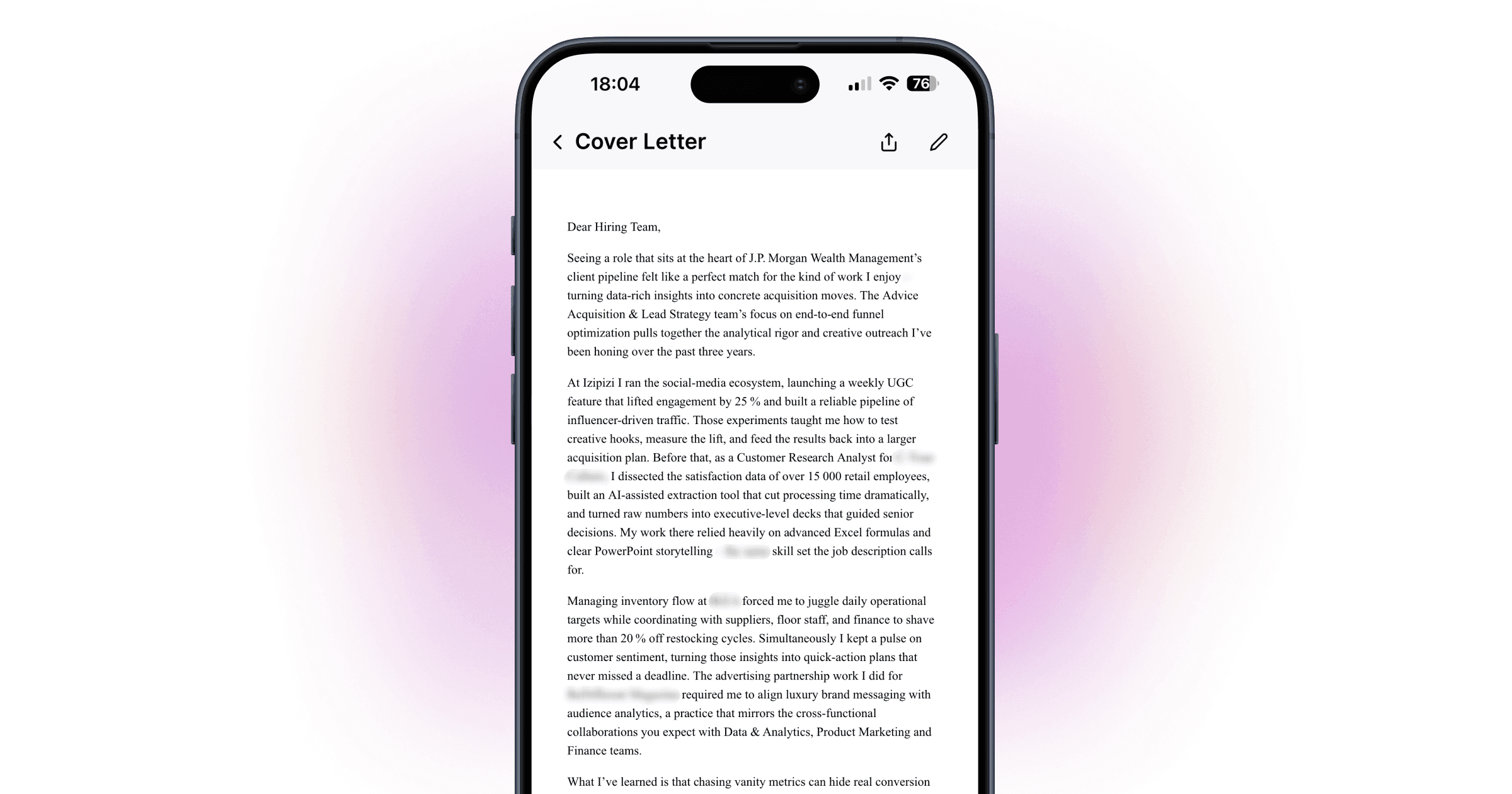
At meaningful application volume, writing this from scratch for every job isn't realistic. Ace generates a role-specific cover letter for every application automatically — it reads the job description and writes something tailored before submitting, so quality doesn't get sacrificed for speed.

Common cover letter mistakes to avoid
Starting with "I," focusing on what you want rather than what you bring, using the same letter for every job with only the company name changed, going over one page, and listing your resume bullet points in paragraph form. For a full breakdown: Cover Letter Mistakes: Why Yours Isn't Getting Read.
A word on AI-generated cover letters
AI tools can generate a cover letter draft in seconds. The quality ranges from useless to surprisingly good depending on how much specific information you give the tool and how heavily you edit the output.
The specific failure mode to avoid: a cover letter that reads as AI-generated because it uses hollow phrases ("passionate about," "proven track record," "dynamic environment"), makes vague claims without specifics, or could have been written for any candidate applying to any job. That kind of letter is worse than not writing one.
The approach that works: give the AI tool specific details - your most relevant achievement, what attracts you to this company, the particular requirement you want to address - and then edit the output heavily until it sounds like you wrote it. Ace analyzes the job description and generates a role-specific cover letter as part of the application flow, building from your real experience rather than producing generic output.
The bottom line
A cover letter that gets read earns its reading in the first sentence. Everything else — the three-paragraph structure, the specificity, the concision — serves that opening. The difference between a cover letter that a recruiter pauses on and one they skip is usually just the first two lines. Get those right, and the rest follows naturally. If generating that first line for every application sounds like too much work at volume, Ace does it automatically — free on iOS and Android.
For advice on the resume that accompanies it: 10 Resume Mistakes That Get You Instantly Rejected. For the mistakes that undermine cover letters: Cover Letter Mistakes: Why Yours Isn't Getting Read.
FAQ
How do I start a cover letter?
Not with "I am writing to apply for..." Start with something specific: a relevant achievement, a genuine reason this company appeals to you, or a direct statement of the strongest match between your background and the role. The goal is to earn the reader's attention in the first sentence.
How long should a cover letter be in 2026?
Three short paragraphs, under 250 words. Longer than that, and most of it won't be read. Shorter is fine if you've covered the three key questions: why this role, what you bring, why this company.
Should I address my cover letter to a specific person?
Yes when possible. Check the job posting, LinkedIn, and the company website for the hiring manager's name. "Dear [Name]" consistently performs better than "Dear Hiring Manager" as a signal of specific effort.
Is a cover letter necessary when applying online?
When it's optional, most candidates skip it — which means submitting one puts you in a smaller, more considered pool. For senior roles or positions where communication skills are part of the job, a good cover letter can be decisive. When a role is purely skills-based and high-volume, the effect is smaller.
Can you use the same cover letter for similar jobs?
The opening and closing should be freshly written for each application. The middle paragraph describing what you bring can stay largely consistent if the roles are genuinely similar — but even small differences in company culture or role focus warrant different framing.