Recruiters spend around 7 seconds on a CV before deciding whether to keep reading. Here's exactly what they're looking for in those seconds.
Eye-tracking studies of recruiters reviewing resumes show a remarkably consistent pattern: most of the initial reading time is spent on a very small area of the page. Job title. Current employer. Education. Dates. A recruiter who's reviewed thousands of resumes has developed an efficient scanning pattern that tells them within seconds whether to keep reading. Understanding what they're looking for in that scan — and positioning your resume accordingly — changes how often you make it to the next stage.
TLDR
Recruiters spend an average of 7 seconds on initial resume review before deciding whether to read further.
Most of that time is spent on: current job title, current employer, dates of employment, education, and the top third of the page.
The structure, layout, and first visible content of your resume are more important than most people realize.
Recruiters are asking one question: does this person roughly match what we need? Everything else comes later.
What the research shows
A widely cited eye-tracking study by Ladders found that professional recruiters spend an average of 7.4 seconds on a resume during initial review, with 80% of that time concentrated on: name, current company and title, previous company and title, start and end dates, and education.
The implication: the structural information on your resume — who you worked for, in what role, for how long — is what recruiters are scanning for first. The content of your bullet points matters enormously for interviews, but it matters less than most people assume for clearing the initial 7-second review.
The top third of the page is everything
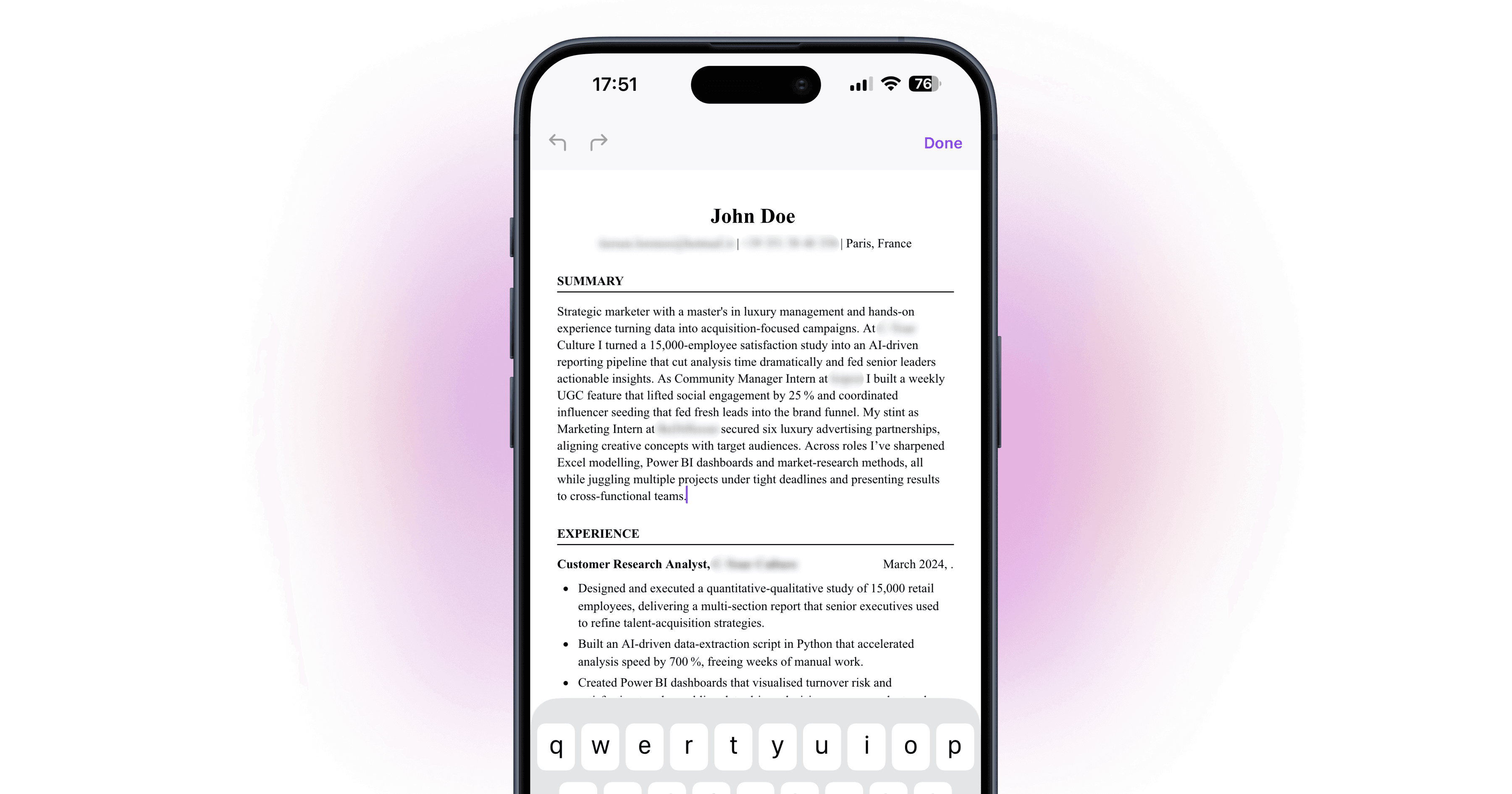
Whatever appears in the top third of your resume is what gets read in those 7 seconds. This is why the professional summary placement matters. A well-written, specific summary that immediately signals relevance to the role buys you more reading time. A generic objective statement or, worse, leaving that space with extensive contact information pushes the signal content further down the page.
Recruiter attention drops off sharply after the first screen of content. Information buried at the bottom of a two-page resume is read by far fewer people than the candidate assumes.
What recruiters are actually asking
The question a recruiter is asking during the initial review is not "is this person good?" It's "does this person roughly match what we need?" That's a much simpler question, and it's answered primarily by: job title proximity to the role, recognizable employer names, appropriate experience duration, and education match.
This has specific implications for how to structure your resume. If your most relevant experience is not your most recent job, find a way to signal that relevance in your summary so it appears in that critical top section. If your current job title doesn't match the role you're applying for, consider whether the summary can bridge that gap.
Ace tailors your resume structure and language for each specific role — free on iOS and Android
What makes a recruiter stop and read
After the initial scan, the decision to read more carefully is triggered by something specific: a recognizable employer, an impressive job title, a number in a bullet point, or a clear match between the candidate's background and a key requirement of the role.
This is why bullet points with specific metrics consistently outperform vague descriptions. "Increased email open rates from 18% to 31% over six months" stops the eye. "Managed email marketing campaigns" does not.
It's also why tailoring your summary to reference the specific role makes a difference. A recruiter who has been looking at generic resumes all day will notice — and pause on — a summary that speaks directly to what they're hiring for. Ace rewrites your summary and tailors your bullet points for each specific role automatically, so every application starts from the strongest possible first impression.

What recruiters find immediately off-putting
Beyond what they look for, there are specific things that create an instant negative impression:
Spelling errors. A typo in the top third of the resume — the section that gets read — is disproportionately damaging. It implies either carelessness or lack of attention to detail, neither of which is the signal you want to send.
Overly elaborate design. A resume that looks more like a graphic design portfolio than a professional document often signals that the candidate is compensating with visual presentation because the content doesn't speak for itself. Simple, clean formatting consistently performs better in recruiter review.
A vague or generic summary. "Experienced professional seeking new opportunities" signals that the candidate didn't tailor the application. Recruiters reviewing hundreds of applications recognize this pattern immediately.
Employment gaps with no context. A gap in employment isn't automatically disqualifying, but a large unexplained gap creates a question the recruiter carries through the rest of the review. A brief, honest label ("Freelance consulting," "Career break - caregiving") eliminates the distraction.
The bottom line
Seven seconds sounds unfair. But it's also predictable and therefore manageable. The recruiter is scanning for a small number of specific signals — title, employer, experience duration, and early relevance. Building your resume around that scanning pattern changes how often you earn the deeper read. A specific, well-placed summary and a clean top third do more work than any visual design choice. If the tailoring and formatting feel like too much to do per-application, Ace handles both automatically for every role you apply to.
For the full list of what causes instant rejection: 10 Resume Mistakes That Get You Instantly Rejected. For handling gaps in your history: How to Explain a Gap in Your CV.
Frequently asked questions
How long do recruiters really spend on a resume? The widely cited figure from eye-tracking research is around 7 seconds for the initial review. This is the time spent deciding whether to read more carefully — not the time spent on resumes that make it through to the shortlist stage, which is significantly longer.
What do recruiters look at first on a resume? Research consistently shows the sequence is: name, current title and employer, previous title and employer, dates, and education. The top third of the page receives the most attention. Your summary and most recent role are the most important sections for clearing initial review.
Does the visual design of a resume matter to recruiters? Yes, but mainly in a negative direction. Elaborate design that makes the resume harder to scan quickly is a liability. Clean, simple formatting that makes the key information easy to find is what works.
Do recruiters read cover letters before resumes? Often no. Many recruiters look at the resume first and only turn to the cover letter if the resume creates interest. This is why your resume needs to earn reading time on its own.
Can you tell within 7 seconds if a resume is ATS-compatible? A recruiter can't — they're looking at the formatted PDF, not the parsed database record. But ATS parsing failures happen invisibly: a recruiter might read a clean PDF while the ATS database has garbled or missing content from it. Both problems need to be solved, and they're solved the same way: single-column layout, standard headings, no tables or graphics.
Make sure your resume passes the 7-second test — try Ace free on iOS and Android
FAQ
How long do recruiters really spend on a resume?
The widely cited figure from eye-tracking research is around 7 seconds for the initial review. This is the time spent deciding whether to read more carefully — not the time spent on resumes that make it through to the shortlist stage, which is longer.
What do recruiters look at first on a resume?
Research consistently shows the sequence is: name, current title and employer, previous title and employer, dates, and education. The top third of the page receives the most attention. Your summary and most recent role are the most important sections for clearing initial review.
Does the visual design of a resume matter to recruiters?
Yes, but mainly in a negative direction. Elaborate design that makes the resume harder to scan quickly is a liability. Clean, simple formatting that makes the key information easy to find is what works. Recruiters aren't looking for impressive design — they're looking for relevant information quickly.
Do recruiters read cover letters before resumes?
Often no. Many recruiters look at the resume first and only turn to the cover letter if the resume creates interest. This is why your resume needs to earn reading time on its own.