LazyApply fires off hundreds of applications automatically. Ace sends fewer, but each one is tailored. Here's which approach actually gets you interviews.
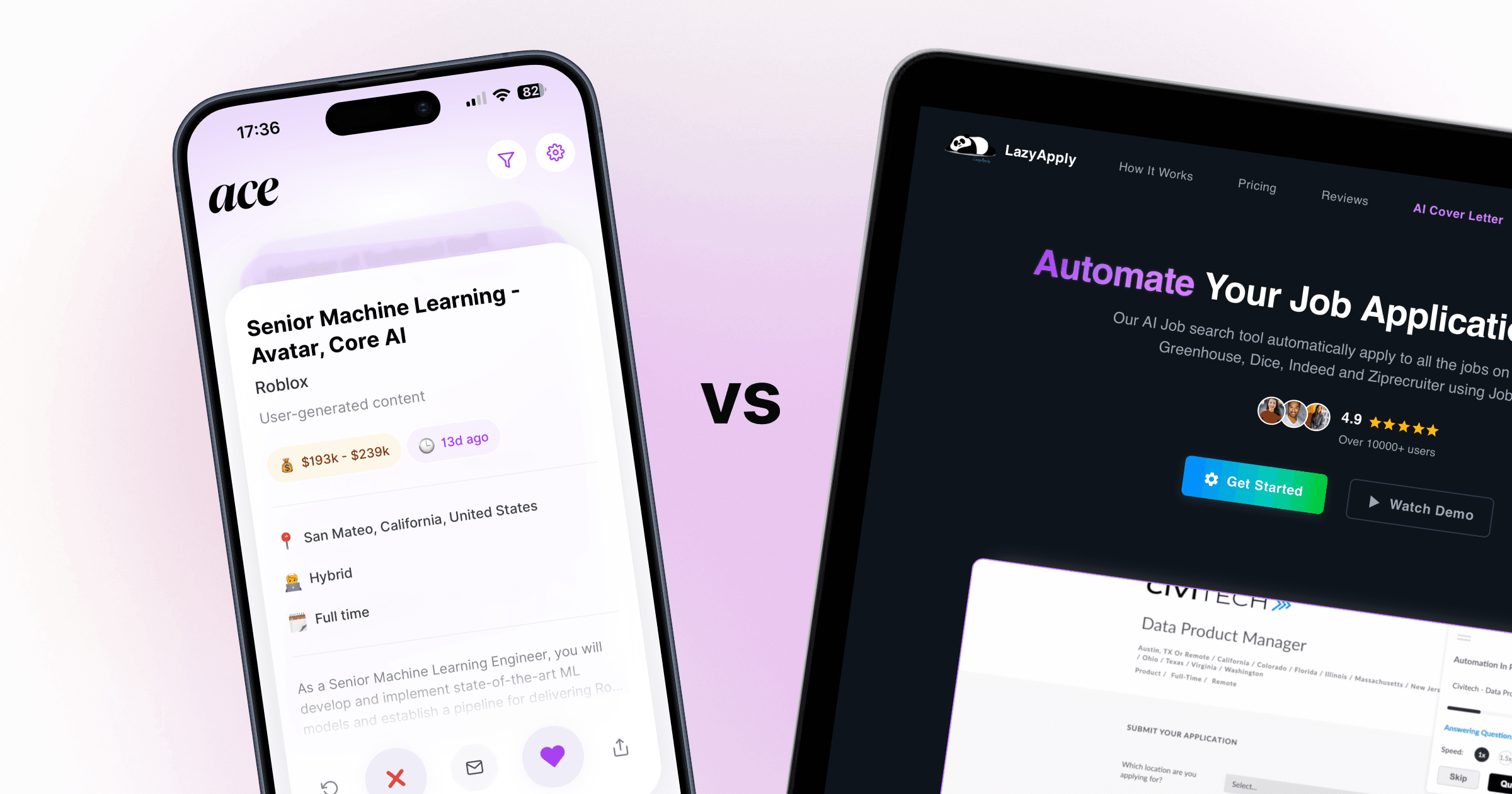
LazyApply has a straightforward pitch: turn it on, and it applies to jobs for you on LinkedIn while you do something else. It can fire off dozens of applications per day without you touching anything. The appeal is obvious. The problem is what gets sent. Every application goes out with the same resume, unchanged, to every role. No tailoring. No keyword optimization. No adjustment for what the employer is actually looking for. In a job market where ATS software filters out roughly 75% of resumes before a human sees them, that approach produces a lot of activity and not much return.
This article is written by the Ace team. We've done our best to represent LazyApply fairly based on publicly available information and user reviews. Pricing and features change — always check LazyApply's current website before making a decision.
TLDR
LazyApply automates LinkedIn Easy Apply at volume. Fast, high numbers, but sends the same resume to every job with no tailoring. Response rates are typically low.
Ace sends fewer applications but tailors your resume and cover letter for each role automatically before submitting on the company's career page. Higher quality per application, better response rates.
Bottom line: If you want to blanket LinkedIn with applications, LazyApply does that. If you want applications that actually get responses, Ace is built for that.
Quick comparison
Feature | Ace | LazyApply |
|---|---|---|
Auto-apply | Yes, full application on company career pages | Yes, LinkedIn Easy Apply only |
Resume tailored per job | Yes, every application | No - same resume everywhere |
Cover letter per job | Yes | No |
Job matching | AI-powered, 8M+ roles/month | LinkedIn filters |
Mobile app | iOS and Android | No - Chrome extension, desktop only |
Free tier | Yes | No |
Starting price | Free | ~$29/month |
How LazyApply works
LazyApply is a Chrome extension that automates LinkedIn Easy Apply. You install it, configure your preferences (role type, location, experience level), connect your LinkedIn profile, and let it run. It works through LinkedIn's job listings, finds roles that match your filters, and clicks through the Easy Apply flow automatically.
The speed is genuine. LazyApply can submit dozens of applications per day without you manually clicking through anything. For job seekers who find the repetitive mechanics of job applications tedious and want the number of submissions to go up fast, it delivers on that specific promise.
What it doesn't do is change what gets sent. Your resume goes out identically to every role. There's no analysis of the job description. No keyword adjustment. No rewriting. The cover letter, if included, is the same one every time. You're mass-mailing a single document to hundreds of companies.
Key features:
Chrome extension for LinkedIn Easy Apply automation
Bulk application submission at volume
Basic application tracking
Referral email generation
Limitations: No resume tailoring per job. Desktop-only — requires your laptop to be open and running. Applies only to LinkedIn Easy Apply roles, not the full job market. Some users report it occasionally autofilling screening questions incorrectly, leading to automatic rejections for things like work authorization or salary expectations.
Bottom line: LazyApply solves the mechanical repetition problem but ignores the quality problem. Volume without tailoring tends to produce high application numbers and low response rates.
How Ace works
Ace approaches the same problem differently. Rather than maximizing volume regardless of quality, it maximizes quality at meaningful volume.
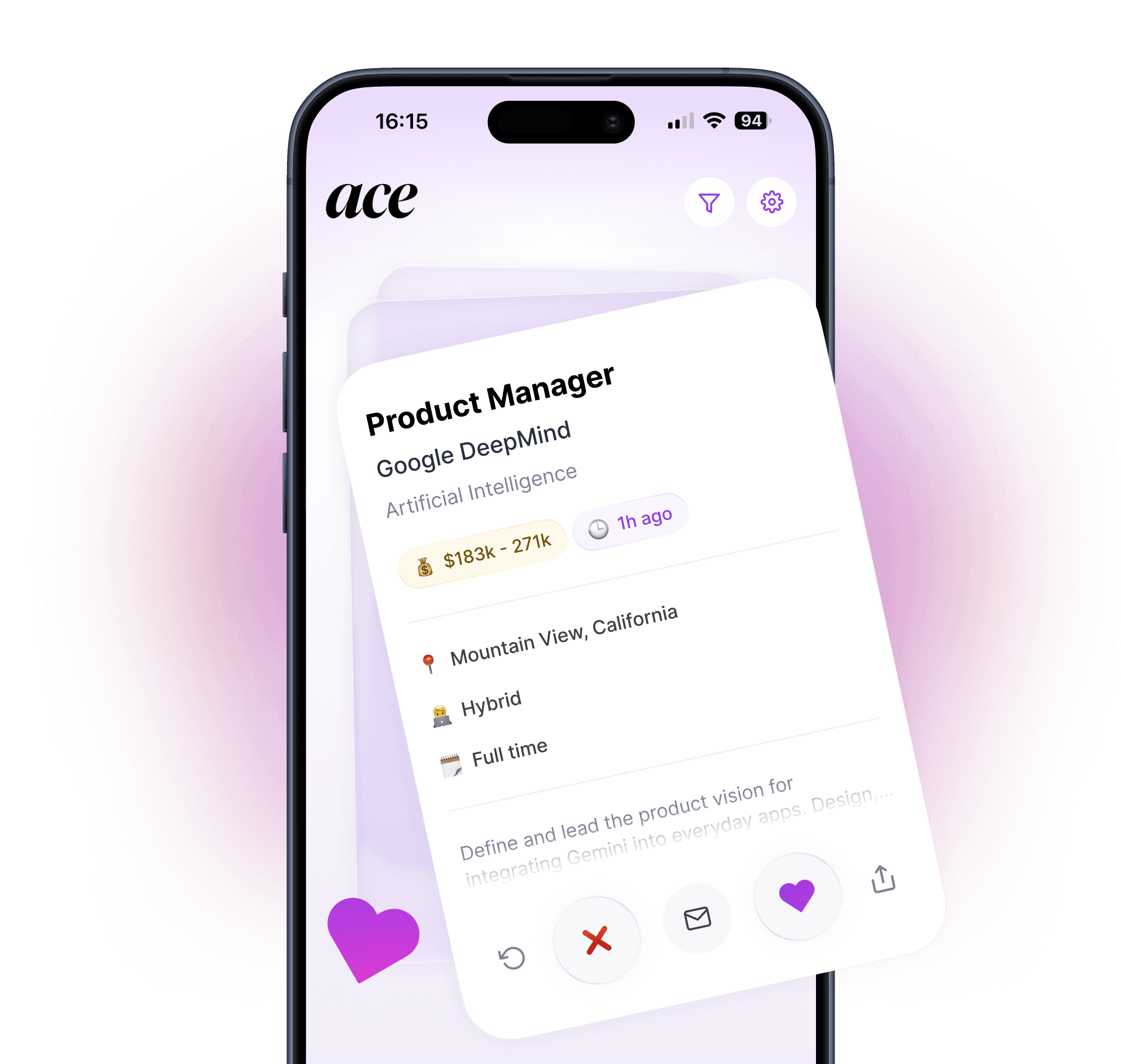
You upload your resume, set your preferences, and browse a curated feed of matched jobs pulled from around 8 million new roles per month — including positions sourced directly from company career pages that don't appear in LinkedIn listings. When you swipe right on a job, Ace analyzes the specific job description and rewrites your resume to match its language, requirements, and keywords. The cover letter is written for that role and that company. Then Ace navigates to the employer's career page and submits the full application directly.
The application goes into the employer's ATS the same way a carefully crafted manual application would — but without you spending 30 minutes per role doing the tailoring and form-filling yourself.
Key features:
AI-powered job matching across 8M+ monthly roles
Swipe-to-apply interface
Resume and cover letter tailored per application automatically
Full auto-apply directly on company career pages
Application tracking dashboard
iOS and Android
Bottom line: Each application is better than what you'd produce under time pressure manually. And the swipe interface makes it fast enough that you can send 20-30 quality applications in the time it used to take to do 3.
Try Ace free on iOS and Android
The core question: does volume or quality win?
This is the real debate between these two approaches, and the answer has become clearer as ATS software has become more sophisticated.
ATS systems score resumes on keyword match against the job description. A generic resume without the right terms for a specific role will score lower than a tailored one, regardless of how experienced the candidate is. Most large employers' ATS systems are set to filter out applications below a certain score automatically. This means a significant proportion of LazyApply's high-volume output never reaches a human reviewer.
The research on this is consistent. Jobscan's analysis of ATS behavior shows that tailored resumes consistently outperform generic ones in keyword scoring. The practical implication is that 30 tailored applications will produce more responses than 200 generic ones — not because quantity doesn't matter, but because quality determines whether the quantity actually counts.
There's also the signal problem. Recruiters who review applications at companies receiving high LazyApply volumes have become aware of the pattern. A generic resume that matches no specific language from the job description, submitted alongside dozens of identical applications, sends a signal that the candidate didn't put any specific effort into this role.

Pricing
LazyApply: No free tier. Pricing starts at approximately $29/month. Higher tiers offer more applications per month. Check LazyApply's current pricing page for up-to-date figures.
Ace: Free to download with a free tier. Full pricing is available in the app. The free tier lets you experience the matching and tailoring before committing.
On cost per application, Ace's model becomes more favorable the more active your job search is, since the tailoring is included rather than traded off against a fixed application budget.
When LazyApply might make sense
There's a specific scenario where the spray-and-pray approach has genuine logic: when you're applying for roles where the screening is done primarily by humans rather than ATS software, and where the barrier to application is low. Very small companies, startups that post on LinkedIn but review applications manually, or roles where your resume is clearly a strong match regardless of keyword optimization.
But this is a narrow use case, and for most job seekers in most markets, the ATS filtering problem makes a generic resume a poor choice even when the candidate is genuinely qualified.
Which one should you use?
Use LazyApply if: You've already tried tailored applications and want to supplement with volume on LinkedIn. You're aware the response rate will be lower. You're specifically targeting LinkedIn Easy Apply roles at smaller companies. You don't mind a desktop-only workflow.
Use Ace if: You want tailored applications at volume without doing the tailoring manually. You want access to a broader job pool beyond LinkedIn. You want to apply from your phone. You care about response rates, not just submission numbers.
The honest framing: LazyApply solves boredom. Ace solves the actual problem.
For a broader look at all the major auto-apply tools available in 2026: Best Auto-Apply Job Apps in 2026.
For a guide on making sure your resume is set up correctly before any auto-apply tool submits it: 10 Resume Mistakes That Get You Instantly Rejected.
Download Ace free on iOS and Android.
Questions about job search automation tools? Reach out at info@aceapp.ai.
Note: This article is written by the Ace team. We've done our best to represent LazyApply fairly based on publicly available information and user reviews. Pricing and features change — always check LazyApply's current website before making a decision.
FAQ
Does LazyApply actually work?
LazyApply does successfully submit applications through LinkedIn Easy Apply automatically. The question is whether those applications produce responses. Because it sends the same untailored resume to every role, ATS filtering means many applications never reach a human reviewer. Response rates from LazyApply users are typically lower than tailored approaches, though volume compensates to some degree.
Is LazyApply safe to use?
LazyApply operates through LinkedIn, which technically prohibits automation tools in its terms of service. LinkedIn has been known to flag or restrict accounts using automation. The risk level varies — many users report no issues, some report temporary restrictions. This is worth factoring in if your LinkedIn profile is a key professional asset.
Can LazyApply tailor resumes?
No. LazyApply sends the same resume to every job. There is no per-application tailoring, cover letter generation, or keyword optimization.
What is a better alternative to LazyApply?
For applications that are actually tailored per role and submitted on company career pages rather than just LinkedIn Easy Apply, Ace is the most complete alternative. It handles job matching, resume tailoring, cover letter generation, and full application submission automatically. See also: [Best AI Job Search Tools in 2026](https://aceapp.ai/blog/tools/best-ai-job-search-tools-2026).
Does Ace work on LinkedIn?
Ace sources jobs from across the web including company career pages and major job boards. Applications are submitted directly on the employer's career site rather than through LinkedIn Easy Apply, which gives access to a broader pool of roles.